
Europe removes record number of dams in 2025 to restore rivers, help species
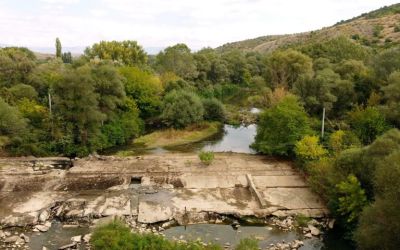
A massive slab of wartime concrete blocked the Pčinja River in Kumanovo, North Macedonia for more than 70 years. A 53-meter-long and 30-meter-wide (174 by 98 feet) structure of reinforced concrete packed with salvaged railway steel impeded the free flow of water and fish for at least 70 kilometers (44 miles) upstream. It was considered […]
A massive slab of wartime concrete blocked the Pčinja River in Kumanovo, North Macedonia for more than 70 years. A 53-meter-long and 30-meter-wide (174 by 98 feet) structure of reinforced concrete packed with salvaged railway steel impeded the free flow of water and fish for at least 70 kilometers (44 miles) upstream. It was considered a safety hazard by the local Shuplji Kamen community.
In late 2025, the barrier was demolished after efforts by the nation’s Eko-svest environmental organization. It was the first large-scale removal of its type in North Macedonia.
It was also one of 603 obsolete river barriers, including dams, weirs and culverts, removed from European rivers in 2025, according to the 2025 Dam Removal Europe report.
Researchers estimated removing those objects reconnected more than 3,740 km (2,324 miles) of rivers across the continent, a new single year record for dam removal in Europe.
“Barrier removal [is] one of the biggest ecological ‘easy wins’ available today,” Chris Baker, director of Wetlands International Europe (WIE) wrote in a statement. “These obsolete barriers no longer provide any benefits, yet they continue to degrade rivers.”
According to WIE, there are roughly 1.2 million barriers in place today that fragment Europe’s rivers, of them more than 150,000 are “considered obsolete.”
Since 2020, nearly 2,300 dams have been removed across Europe, mostly in Sweden, Finland and Spain. Iceland, along with North Macedonia, carried out its first removal in 2025. Iceland removed an old hydroelectric dam that was no longer in use.
The barrier in North Macedonia was harming at least 10 fish species, including four endemic species like the Vardar bitterling (Rhodeus meridionalis), which is one of just two bitterling species in Europe. The barrier made it impossible for fish to swim upstream to breed.
In southern France, the removal of the Isaby dam opened a tributary of the Gave de Pau River for threatened species including vulnerable Atlantic salmon (Salmo salar) and the Iberian desman (Galemys pyrenaicus), a small insectivorous mammal related to moles. The dam was demolished in October 2025, restoring up to 10 kilometers (6 miles) of the river network.
According to a recent report by the European Red List of Freshwater Fishes, 42% of Europe’s freshwater fish species “are threatened with extinction.”
In 2024, the EU’s Nature Restoration Regulation set a target to restore at least 25,000 kilometers (15,534 miles) of rivers to a free-flowing state by 2030. In 2025, 15% of that target was met.
“Healthy rivers are critical natural infrastructure, living systems that provide flood protection, water security, biodiversity and climate resilience,” Baker said in the statement. “People increasingly understand that obsolete dams do not need to stay forever.”
Banner image: Drone image of the Pčinja River before and after the Shuplji Kamen barrier removal in North Macedonia. Images © Eko-svest.