
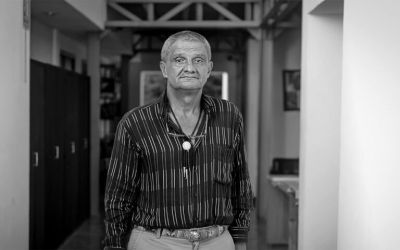
Brooklyn Rivera, defender of Nicaragua’s Indigenous lands, dies in detention
  La Moskitia, on Nicaragua’s Caribbean coast, is often treated in Managua as a frontier: timber, gold, cattle, rivers, votes, and military concern. To the Miskitu, Sumu-Mayangna, Rama, Garífuna, and Creole peoples who live there, it is older than the Nicaraguan state. Its forests, savannas, rivers, and marine life are part of a political claim […]
La Moskitia, on Nicaragua’s Caribbean coast, is often treated in Managua as a frontier: timber, gold, cattle, rivers, votes, and military concern. To the Miskitu, Sumu-Mayangna, Rama, Garífuna, and Creole peoples who live there, it is older than the Nicaraguan state. Its forests, savannas, rivers, and marine life are part of a political claim as well as a homeland. The demand has long been plain enough: land, autonomy, and a say over what happens there.
Brooklyn Rivera Bryan spent most of his life carrying that demand into war, negotiation, electoral politics, exile, and prison. Known in Miskitu communities as Taupla Brooklyn, he died on May 30th, aged 73, in the custody of Daniel Ortega’s government. He had been detained since September 2023. For months the government denied holding him. It later acknowledged his imprisonment. No public trial was held. His family was denied visits.
His public life began after the Sandinista revolution of 1979, when the new government sought to draw the Atlantic Coast into a national project directed from the Pacific. The Miskitu experience of that project was marked by surveillance, arrests, violence, and forced displacement. In 1981 Rivera was arrested while leading Misurasata, an Indigenous organization whose name linked the Miskitu, Sumu, Rama, and Sandinistas. By 1982, thousands of Miskitu had been moved from villages along the Río Coco. Many fled to Honduras. Rivera’s cause was narrower and more durable than the Cold War frame around him: an autonomous Indigenous territory in Yapti Tasba, the aboriginal homeland.
That aim made him a fighter, then a negotiator. In the late 1980s he helped form Yatama, Yapti Tasba Masraka Nanih Aslatakanka, often translated as Sons of Mother Earth. He pressed for repatriation of refugees and argued for self-government over hunting and fishing, agriculture, natural resources, social services, and education. Autonomy for Nicaragua’s Caribbean Coast was written into the constitution in 1987. It was a large achievement, and an incomplete one.
For Rivera, autonomy meant legal title, territorial control, and protection against the old extractive economy of La Moskitia. He wrote of a region rich in forests, soil, subsoil, fauna, and marine life. He also wrote of timber, gold, bananas, gum, and seafood as industries that had long treated the coast as a storehouse. In 2016 he described a newer invasion: armed settlers entering Indigenous lands, cutting mahogany and cedar, clearing forest for pasture, fencing communal property, and opening rivers and Indigenous areas to gold mining. The issue was environmental, legal, and existential at once. Forest loss meant land loss. Land loss meant the weakening of a people.
That was the center of his politics. It also explains his uneven relationship with power. In 2006, Yatama entered an alliance with the Sandinistas, whose return to office came with promises to title Indigenous and Afro-descendant territories and resolve land disputes. Rivera became a legislator in 2007 and served as an intermediary between the coast and Managua. He later broke with the ruling party, accusing it of fraud, unilateral rule, and failure to secure Indigenous lands. The proposed interoceanic canal, approved without consultation though it crossed ancestral territories, deepened the breach. In 2015 he was stripped of his legislative seat after accusations he called a political setup. He answered that before being a legislator he had been a leader, and the struggle for land would continue.
Rivera was not a simple figure. Few people who spend five decades inside the politics of war, autonomy, patronage, party alliances, and survival remain simple. He made accommodations. He angered allies. He could be indispensable and difficult. His steadier line ran through the Atlantic Coast: the belief that Indigenous peoples had rights that preceded the republic and could not be dissolved by ministries, soldiers, party councils, or settlers with papers of uncertain origin.
During the uprising against Ortega in 2018, Rivera said Yatama supported the people and opposed repression, while acting from the interests of Indigenous peoples. He warned that the Sandinista regime had applied a policy of internal colonialism since the 1980s. His answer was unity and resistance based on identity, joined to the wider national struggle for rights.
In 2023, after speaking at a United Nations forum on Indigenous issues, he was barred from returning to Nicaragua. He entered anyway, by unofficial routes through the Moskitia. In a final public video he said he accepted the risk out of love for his land, communities, and people. Months later he was arrested at his home. Yatama’s legal status was revoked. His alternate was detained. His seat was handed to a Sandinista legislator.
His death in custody gave his life a severe symmetry. Confidencial, an independent Nicaraguan media outlet, reported that his final wish was burial beside his mother, Pulcida, in Lidaukra. Even that final return was denied. La Moskitia was the argument of his life. It remained, at the end, the place he was not allowed to reach.
Banner image: Brooklyn Rivera. Photo courtesy of Intercontinental Cry (IC).