
Syria's government begins to return Alawi lands, while maintaining its hold over others
Syria's government begins to return Alawi lands, while maintaining its hold over others Submitted by Natacha Danon on Mon, 06/01/2026 - 09:09 Displaced Alawi farmers tell MEE that their homes and land have been occupied by Sunni neighbours and administered by a powerful state company called Iktifaa
Ahmed Ali says he was fired from his job as a Syrian civil servant in 2019 for refusing to do his mandatory military service.
“I refused to join the army and kill people,” Ali, who is using a pseudonym, told Middle East Eye.
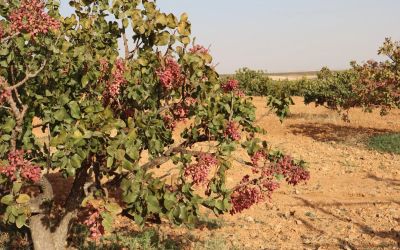
After his dismissal, he decided to dedicate himself to his pistachio farm – 150 dunums (15 hectares) of trees in the northern Hama countryside that has been in the family for more than 50 years.
Before the 2011-2024 civil war broke out, Syria’s multimillion-dollar pistachio industry ranked fourth in the world.
During the conflict, northern Hama - the pistachio heartland - became the front line between the Syrian army and rebel factions.
Picturesque villages became hotspots for sectarian violence between Sunnis, the community that most rebels were drawn from, and Alawis, the sect that the former president, Bashar al-Assad, belongs to.
Thousands of Sunnis were displaced from their lands and cut off from their livelihoods by fighting and arbitrary arrests.
When a lightning rebel offensive removed Assad’s government in late 2024, many of those Sunnis were able to flock back to their villages.
'Our goal is to restore civil peace, and our thinking is that of a state and its institutions, not that of a faction'
Alawis, meanwhile, fled their land, fearing rebel factions would identify them with Assad and stage reprisal attacks.
When many Sunni pistachio farmers returned, they found their homes in ruins, land scarred, and trees uprooted.
As a result, they settled in the homes of their erstwhile Alawi neighbours.
“It took four or five months before I knew one of my former neighbours was living in my home,” Ali says.
“I couldn’t do anything about it, so I said he could stay in the hopes he would provide me with a share of my pistachio harvest.”
Instead, Ali discovered that his lands had been seized by the state, and his harvest taken by his neighbour and a company he had never heard of before: Iktifaa.
“When I went to Iktifaa to get my lands back, they claimed there were security studies saying I was a shabih [Assadist thug] who had committed crimes, without specifying what they were,” he says.
Iktifaa is a state-owned agricultural investment company headquartered in northwestern Idlib province with roughly 500 employees, Monzer Khattab, the head of the Hama and Homs branch, told Middle East Eye.
During the war, it managed land in opposition-held areas that was owned by Syrians who had been displaced, including Druze and Christians.
Today, Iktifaa is employing a similar strategy towards displaced Alawis.
While the state has restored property rights to many Alawis this year, thousands remain without access to their lands.