
Intense heat during Mecca’s spring threatens millions of Hajj pilgrims
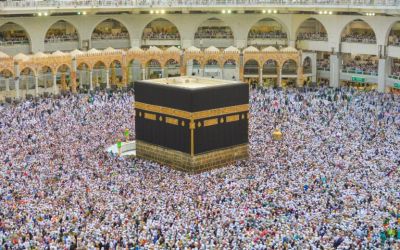
As millions of Muslims gather for the Hajj pilgrimage in Mecca, Saudi Arabia, a new scientific analysis warned the “safe window” for the event is shrinking, with increased risk of heat exhaustion and heat stroke due to human-induced climate change. The report was released by the World Weather Attribution (WWA), an initiative that analyses the […]
As millions of Muslims gather for the Hajj pilgrimage in Mecca, Saudi Arabia, a new scientific analysis warned the “safe window” for the event is shrinking, with increased risk of heat exhaustion and heat stroke due to human-induced climate change.
The report was released by the World Weather Attribution (WWA), an initiative that analyses the role of climate change in extreme weather events.
The Hajj follows the Islamic lunar calendar, which is 10-15 days shorter than the more commonly used solar Gregorian calendar. This means dates of the Hajj shift earlier each year.
Historically, the month of May in Saudi Arabia had milder temperatures compared to the summer months of June to September. Researchers from the WWA found May temperatures in Mecca now mirror the intense summer heat typical of the 1980s.
Climate change has led to average May temperatures in Mecca surging by roughly 3.5°Celsius (6.3°Fahrenheit) compared to a pre-industrial climate, before the accelerated release of human-triggered greenhouse gases. Peak temperatures for May are now about 2°C (3.6°F ) hotter.
“Climate change has once again shown us that expectations based on a climate that no longer exists can be thrown out of the window,” report co-author Clair Barnes , a research associate at Imperial College London, said in a statement. “Our analysis shows very clearly that less of the year is now safe for the millions of Muslims who wish to undertake the Hajj.”
The risks are acute for pilgrims who spend 20 to 30 hours outdoors, often walking long distances in dense crowds, the report noted. Maximum temperatures exceeding 40°C (104°F) in May, once outliers, are now expected to occur every two to three years.
The report added in 2024, more than 1,300 pilgrims died during the Hajj, which took place in June, coinciding with a heatwave reaching 51°C (123.8°F).
Saudi authorities have implemented measures like misting fans and cooling stations to lessen the impacts of heat during Hajj. However, the report highlighted these measures may not be accessible to all, particularly those without official permits.
“Measures like misting fans and water stations are vital, but we must face the reality that if temperatures continue to climb at this pace, the health and lives of millions during their pilgrimage is at risk,” Emmanuel Raju, director of Copenhagen Centre for Disaster Research, University of Copenhagen in Denmark, said in a statement.
The report cited research indicating that if global temperatures rise by 3°C (5.4°F ) by 2100, approximately 97% of all Hajj pilgrimages will take place during periods of dangerous extreme heat.
Friederike Otto, a professor of climate science at Imperial College London, said in a statement while the fossil fuel industry is at the very center of the Saudi economy, it forces pilgrims “to carry out the Hajj rituals in a climate that is simply unsuitable for it.”
Banner image of the Kabba during Hajj. Image by Adli Wahid (CC BY-SA 4.0).