
British Intelligence Turned This Mansion Into a Bugged Spy Trap for Nazi Prisoners of War During World War II
Visitors can now tour the house, where German generals relaxed and gabbed upstairs while Jewish refugees working as spies and translators for the British government listened in from the basement
The secret listeners recorded conversations onto acetate discs. Trent Park House of Secrets London’s newest museum is a time capsule of British espionage. The Trent Park House of Secrets looks from the outside like any old Georgian mansion. But during World War II, it was filled with Nazi prisoners of war—and bugged to the gills.
In the 1940s, Allies allowed captive German higher-ups to live comfortably on the opulent house’s upper floors. All the while, “secret listeners” in the basement eavesdropped on their conversations, gathering intelligence.
“We are right in the middle of living, breathing history,” said museum director Giuseppe Albano at a recent press conference, per the Enfield Dispatch. “It shows the extraordinary layers of history of Trent Park and the thrilling drama this place has.”
Trent Park House lies just north of England’s capital, on a historically noble parcel of land. In 1912, Sir Philip Sassoon inherited the property from his father, a successful Jewish merchant, and renovated its Victorian mansion to match Georgian style. “The result was a house of great refinement and noble simplicity, the perfect weekend party venue,” per the museum. Throughout the 1930s, the wealthy Sassoon hosted the likes of Winston Churchill, Charlie Chaplin and George Bernard Shaw. He died in 1939.
That September, Britain declared war on Germany, and Sassoon’s mansion was conscripted. Lieutenant Colonel Thomas Kendrick of MI19—a “military intelligence” unit like the familiar MI6—had Trent Park House transformed into a surveillance center. According to the museum, this meant installing administrative offices and interrogation rooms out front and filling the house with miniature listening devices—in walls, baseboards, light fixtures, indoor plants, garden benches and a pool table. Then, Allies deposited captured German officers at Trent Park House.
Visitors to the new museum can examine the workings of this operation. On the first floor is a display of the technology used to listen to the Germans’ conversations, as well as a miniature model of the mansion: “a doll's house of reconnaissance,” writes Londonist’s Matt Brown. The model is filled with dolls of German officers in uniform, seemingly in casual conversation.
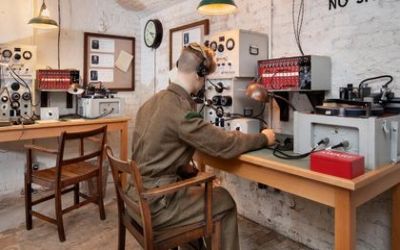
The spying occurred in the basement. Visitors can tour the mansion’s subterranean rooms, which have been restored to mimic how they looked in the early 1940s: storage rooms, a supervisor’s office and listening stations—desks full of large, boxy recording equipment. At the chairs sit dummies dressed in British military garb, wearing earphones, hands in note-taking position.
During Trent Park House’s first few years of operation, its “secret listeners” were British operatives fluent in German. But by early 1943, Kendrick needed more manpower and better decipherers who could understand the technical language and German dialects used by the POWs. So MI19 recruited about 100 Jewish refugees from Germany, who “were able to understand every informal word and utterance” said by the prisoners of war.
The secret listeners worked in shifts in squads of six. They listened via headphones, recorded conversations onto acetate discs, then transcribed their recordings.
What kinds of messages did they hear? Notably, Trent Park House operatives learned of Germany’s V-2 rockets, long-range ballistic missiles. As the Guardian’s Eddy Frankel reports, the operatives offered Trent House conversational snippets to the cryptanalysts attempting to break the Axis Enigma code. And, apparently, the prisoners of war let slip that German planes communicated via transmitted beams.
The operatives also heard “appalling details about the Nazi concentration camps,” per Londonist. But British authorities didn’t act on that intelligence. As the Guardian reports, “they didn’t even submit the intelligence to the Nuremberg trials in the 1950s, worried their secret tech would be exposed.”
Between 1944 and 1945, Germany launched hundreds of V-2 rockets at London, killing thousands of people. According to David Alan Johnson reporting for Warfare History Network, these rockets “traveled with the velocity of a rifle bullet, and could not be seen, let alone destroyed. They exploded on their targets before the sound of their travel arrived.”
The British comedian Helen Lederer is a trustee of the Trent Park Museum Trust. Her grandfather was a secret listener at the mansion, a “secret he took to the grave,” she says in a statement. “It means so much that this chapter of little-known history can be told through the museum. To imagine what the secret listeners may have felt as they listened to the captive generals upstairs is as important as it is humbling.”
Intelligence work at Trent Park House wasn’t limited to the basement. Some operatives worked as “stool pigeons,” infiltrating and manipulating the German prisoners’ conversations to tease out important information. One such stool pigeon was Ernst Lederer, a Czech Jewish refugee who, per the museum, helped the MI19 determine the rankings and duties of the Nazi prisoners.
In total, 59 German generals were imprisoned at Trent Park House. The new museum is focused not only on its espionage history, but its status as a cultural gathering place beforehand. Albano emphasizes in the statement that the house represents some of British history’s most colorful and turbulent years.
As Jason Charalambous, founder and co-chair of the Trent Park Museum Trust, tells the Art Newspaper’s Maev Kennedy, “This is a story that needed to be told.”
Sonja Anderson is a daily correspondent for Smithsonian magazine who covers art, archaeology and culture, from newly discovered artifacts to the latest art heists.