
Oil has harmed the nature and people of the Niger Delta; human rights may save it
On this week’s episode of the Mongabay Newscast, I speak with travel writer Noo Saro-Wiwa. She has documented the violence and natural destruction that the presence of oil companies have brought to the people of the Niger Delta in her latest book, The Burning Ground: Oil and Militancy in Nigeria. Saro-Wiwa is also the daughter […]
On this week’s episode of the Mongabay Newscast, I speak with travel writer Noo Saro-Wiwa. She has documented the violence and natural destruction that the presence of oil companies have brought to the people of the Niger Delta in her latest book, The Burning Ground: Oil and Militancy in Nigeria.
Saro-Wiwa is also the daughter of the late activist Ken Saro-Wiwa, who was executed by the Nigerian government in 1995. Her father led a peaceful resistance against the oil companies’ presence in the Niger Delta by mobilizing 300,000 people from Ogoniland in 1993. It is fair to say his activism started the movement against the destruction and exploitation led by oil companies in the nation. While peaceful at first, Noo Saro-Wiwa says many people gave up hope on peaceful resistance when the government failed to hold the companies accountable, and men turned to forming violent militant groups.
“Oil has been literally the worst thing that’s happened to the Niger Delta. If I could go back in time and I had the power, I would never have allowed oil to have been discovered,” she says.
“ The amount of instability, political, economic instability it causes. And the damage to the environment … that goes without saying. So we really need to shift to solar power … oil companies do not have this kind of leverage over people, and governments will have no incentive to go in and destroy people’s lives.”
While her latest book chronicles the harm of oil and the resulting violence, I put it to her that it’s also a story about how the absence of women’s rights is destroying societies. Saro-Wiwa explains how Nigeria isn’t unique in this regard, but rather a stark example of how this dynamic plays out.
“ Going around the Niger Delta and talking to activists like Emem Okon … I could see very clearly how women’s rights directly affects the environment … and society, and how the absence of those rights feeds into this militancy which ultimately hurts men.”
In reading Saro-Wiwa’s book, she doesn’t push a solution upon you, but I do believe one reveals itself in her conversations with civic leaders and ex-militants. Many of them tell her, in so many words, that if the government cared less about supporting oil companies and more about supporting the people — especially women — who are actually trying to restore the region’s livelihoods, farms, nature and peace, then the delta could truly develop.
Her conversations with ex-militants now reformed and working in agriculture, such as a man named Mac-Eteli, reveal a sentiment that the government’s priorities are askew. Instead of supporting the people working to bring sustainable development to the region, the Nigerian government started providing financial incentives to militants to leave violence behind in 2009. Ironically, this has only seemed to beget more violence as disaffected men turn to militancy — and the promise of a government stipend to give it up.
“ The government has done things completely the wrong way round. It’s having to spend billions of dollars in monthly stipends to pay off these to pacify militants, when really … those billions should have gone towards promoting farmers like Mac-Eteli. It should have gone towards educating the young people of the Niger Delta so that they can then go on and create job opportunities for themselves and for other people,” Saro-Wiwa says.
Much of the work that Saro-Wiwa says the government should be doing is done by women, and in her conversations with them, it swiftly becomes apparent that they are not just undervalued, but marginalized, to the detriment of Nigerian society. All the while, oil continues to propagate in the region, polluting the delta, and giving little back to the people it is harming.
“A lot of women are farming the land. But the problem is that when there is an oil spill, the government … if they’re gonna give any money or compensation, they’ll give it to the men, not the women,” she says. “But it’s the women who are looking after the children. It’s the women who are farming the soil.
“ If the women are taken care of, the children are taken care of. And if the children are taken care of, then you don’t have these young boys going off and wanting to become militants. So everything boils down to looking after women. That is how you fix society.”
The Burning Ground is a harrowing read, but of all the books I’ve read for this podcast, it might be the very first one I suggest you pick up.
Please take a minute to let us know what you think of our podcast here.
Mike DiGirolamo is the host & producer for the Mongabay Newscast based in Sydney. Find him on LinkedIn and Bluesky.
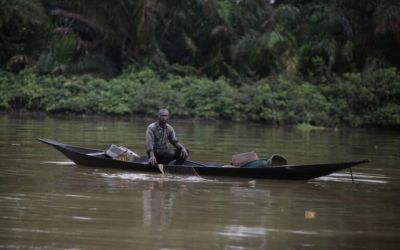
Banner image: A man fishes in the Niger Delta near the village of Diebu, Nigeria, Saturday, May 18, 2013. Image by Jon Gambrell / AP Photo.
Noo Saro-Wiwa: We talk about women’s rights because we believe in it on principle, right? But a lot of people, and particularly men in Nigeria, when they hear the word women’s rights, they just tune out. They’re not really thinking about it. And I think going around the Niger Delta and talking to activists like Emem Okon, I could see very clearly how women’s rights directly affect the environment, the natural environment and society, and how the absence of those rights feeds into this militancy, which ultimately hurts men. It’s a very clear, rational, logical rationale there, and I was just struck. I think the Niger Delta really illustrates that more clearly than in any other society.
Mike DiGirolamo: Welcome to the Mongabay Newscast. I’m your host, Mike DiGirolamo, bringing you weekly conversations with experts, authors, scientists, and activists working on the front lines of conservation, shining a light on some of the most pressing issues facing our planet, and holding people in power to account. This podcast is edited on Gadigal land. Today on the newscast, we speak with writer Noo Saro-Wiwa, who is also the daughter of the late activist Ken Saro-Wiwa, who was executed by the Nigerian government in nineteen ninety-five. Her father led a peaceful resistance against the presence of oil in the Niger Delta in the nineteen nineties. But I’ll let her explain that more in her own words. Today, we talk about her latest book, The Burning Ground: Oil and Militancy in Nigeria. It’s a story about how the presence of oil is destroying the lives and the nature of the Niger Delta and fueling armed insurgency in militant groups. But I also believe it is a story about how the absence of women’s rights is destroying societies. What emerges from this book and this interview is that women’s rights directly affect the environment and society, and how the absence of those rights feeds into militancy, which ultimately hurts everybody. It’s clear the presence of oil has not helped the people of the Niger Delta develop, and if anything, it has only harmed the environment and their lives and led to violence. In reading Saro-Wiwa’s book, she doesn’t quite push a solution upon you, but I do believe one reveals itself in her conversations with civic leaders and ex-militants. Many of them tell her in so many words that if the government cared less about supporting oil companies and more about supporting the people who are actually trying to restore the region’s livelihoods, farms, nature, and peace, then the Delta and Nigeria could truly develop. Much of this work is done by women, and in Saro-Wiwa’s conversations with them, it swiftly becomes apparent that they are not just undervalued but marginalized to the detriment of Nigerian society. Providing financial incentives to militants to leave violence behind, ironically, only seems to beget more violence as disaffected men turn to militancy and the promise of a government stipend to give it up. All the while, oil companies continue to propagate the region, polluting the Delta and giving little back to the people it is harming. It’s a harrowing read, but of all the books that I’ve read for this podcast, it might be the first one that I suggest you pick up. Hi, Noo. Thank you for joining us. Welcome to the Mongabay Newscast.
Mike: So we’re gonna be talking about your book, The Burning Ground, over the course of this conversation. But to just set a context for our listeners, and I know this is a really large question, but can you explain how, as you outline in the book, instead of becoming wealthy through oil, the people of the Niger Delta have paid a heavy price for it?
Noo: Yeah. Well, the Niger Delta is one of the biggest eco wetland systems in the world. It’s where the Niger, the Niger River, drains into the Gulf of Guinea. So it’s a very kind of rich, fertile area. There are thousands of small river channels. And so for hundreds of years we’ve been farmers, fishermen, and that’s how we’ve sustained ourselves from this very rich, fertile soil. And then oil came along, and rather than it enriching us, it’s damaged and polluted the environment, and the proceeds of the oil have gone to enrich multinational companies like Shell and a succession of corrupt military dictatorships. So we haven’t seen any of the financial benefits of the oil, but what we have done is seen the complete degradation of our environment. Thousands of oil spills have occurred since oil was discovered in the 1950s, and so it’s left us between a rock and a hard place. Oil hasn’t helped us develop economically, but at the same time, it’s prevented us from continuing the subsistence agricultural economy that we’ve relied on all this time. And that’s why my father, Ken Saro-Wiwa, described it as a genocide. When you prevent people, when you take away people’s fundamental livelihoods, you poison the water that they drink, the soil that they grow food from, and then you provide them no alternatives. They can’t get an education, they can’t get a decent education, and they can’t get alternative jobs in the cities. Then are you really sort of, there’s an existential problem there.