
The Tax Screw in Berlin, Germany
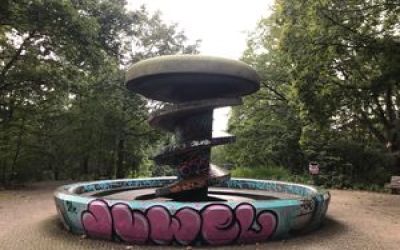
The Rehberge in the Wedding district is a green space that was originally a dune landscape of the Berlin glacial valley (Urstromtal). Illegal logging after the First World War led to the silting up of the terrain, so much so that the Rehberge could even be used as a backdrop for a desert film during the silent film era. When the Rehberge was redesigned as a landscape park, first in 1918/19 and the
The Rehberge in the Wedding district is a green space that was originally a dune landscape of the Berlin glacial valley (Urstromtal). Illegal logging after the First World War led to the silting up of the terrain, so much so that the Rehberge could even be used as a backdrop for a desert film during the silent film era. When the Rehberge was redesigned as a landscape park, first in 1918/19 and then from 1926-1929, the elevations were integrated into the garden architecture. According to the plans of its founder, Alfred Brodersen, a toboggan run was planned, which descended from the end of the "High Trail" over the so-called Sickle Dune Ridge with a fabulous incline of 20 meters. In the 70s, it was cult for the kids of Wedding to hurl themselves down the "Death Run" (Todesbahn) when there was enough snow. No fatalities are known, but plenty of blue bruises and sprained joints resulted.
During this time, the space in front of the toboggan run was empty. We could not have known that a historically significant structure once stood here.
In 1930, a monument, created by Georg Kolbe, was erected in honor of the legendary politician and entrepreneur Walther Rathenau, who was murdered in 1922, and his father Emil Rathenau, the founder of AEG.
The fountain had an abstract shape, consisting of a 6-meter-wide bronze bowl from the center of which an approximately 4-meter-high, widening spiral grew, topped with a mushroom-shaped cover. Berliners love nicknames for striking buildings, so the fountain quickly acquired the popular name "Steuerschraube" (Tax Screw) as an ironic comment on the tax policy of the Weimar Republic.
As early as 1934, the fountain was dismantled at the behest of the National Socialists and melted down in 1940. The metal was used to recast the damaged Schiller Monument in the park of the same name in Wedding. The Rathenaus, being Jews and liberal politicians, were to be erased from the collective memory.
After a decision was made to reconstruct the fountain for the 750th anniversary of Berlin, a reconstruction of the monument based on old pictures and construction plans was erected on July 9, 1987. The extensive restoration work required for this was carried out by the sculptor Harald Haacke, adhering to the original design by Georg Kolbe.
Since then, the "Tax Screw" has once again stood in new beauty, just as in the old days, and is again defaced with tags, at the drop-off point of the "Death Run." And when the weather is nice and the State of Berlin has the money, the water splashes down as a transparent curtain into the bowl below, where children play.