
‘Chasing Deforestation’ in Liberia: Behind the scenes with Mongabay
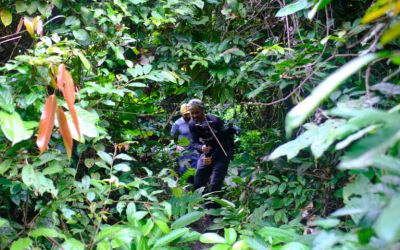
Mongabay’s investigation into deforestation in Liberia started with a tip from a source last year. “There’s deforestation, and a migrant rights issue,” they said. Areas along the border with Côte d’Ivoire were losing vast swaths of rainforest to cacao farming. It was the beginning of a months-long journey that led us from the Liberian jungle […]
Mongabay’s investigation into deforestation in Liberia started with a tip from a source last year.
“There’s deforestation, and a migrant rights issue,” they said. Areas along the border with Côte d’Ivoire were losing vast swaths of rainforest to cacao farming.
It was the beginning of a months-long journey that led us from the Liberian jungle to the European Parliament in Strasbourg, and through the history of West African labor migration.
As a features writer for Mongabay’s Africa bureau, my work has brought me across the world. I’ve covered conservation conflicts, climate change, and the legacy of commodity extraction. These stories are always a window into the interconnected forces of modern life: economic inequalities, history, ecological change, geopolitics, and so on.
I often joke that environmental reporters are really on every beat at once. Our societies were built on the exploitation of nature, and control over resources is one of the most fundamental expressions of power. Scratch the surface of an environmental story, and you’ll find one about how decisions are made, who gets to sit at the table, and what really matters to them.
But few stories I’ve covered in my career pulled as many threads together as this one did.
The tip wasn’t the first I’d heard of land deals for cocoa production in southeastern Liberia, an area where I’ve worked and reported in the past. Since 2024, civil society groups like Côte d’Ivoire’s IDEF have warned that a new, largely unregulated trade was emerging in the densely forested, hard-to-reach border regions.
But nothing prepared me for what I saw when I opened the dashboard of Global Forest Watch, a U.S.-based organization that compiles deforestation data from satellite imagery. Pink alert dots blanketed parts of the southeast, where much of Liberia’s remaining primary rainforests are located. The dots indicated that a satellite had flagged an image of possible deforestation.
These alerts were recent, suggesting that a huge amount of forest had been destroyed in just the past year or two.
The scale was hard to believe, so I called our senior editor, Morgan Erickson-Davis, for a second opinion. She confirmed that the alerts looked legitimate — in some cases you could see patches of forest loss in grainy photos captured by the satellites.
The worst of the damage looked to be taking place in Grand Gedeh, a county known for its endangered wildlife and heavy forest cover. I started making calls to people I knew in Liberia to find out if they’d heard anything.
The answer came back: there was a “cocoa rush” happening there, as environmental journalist James Giahyue put it, and it was much bigger than most people understood.
A few months later, I was in Grand Gedeh along with James, Mongabay video producer Juan Maza, and freelance videographer Jose Gomez. Over the next week, we traveled by Land Cruiser, motorcycle, and on foot across the county to talk to people and see what was happening for ourselves.
We slept inside the rainforest, hauling our equipment down swampy trails with the help of eco-guards from the Wild Chimpanzee Foundation, who brought us to illegal cacao farms that looked like gashes in the canopy. Forest rangers took us on foot patrols in protected areas, where we witnessed migrant workers being arrested. We spoke to those workers, along with the Liberian landowners they’ve cut deals with who see the cocoa destroying the forest as their ticket to a better life.
What we found touched on climate change, cross-border migration, commodity geopolitics, and Europe’s attempt to slam the brakes on an agricultural production system it largely built a century ago in places like West Africa, but which is now eating the planet’s forests.
Across the border in Côte d’Ivoire, climate-related weather disruptions and soil nutrient loss have strained cacao yields in recent years. That’s caused the price to fluctuate wildly: in 2024, it quadrupled in less than a year. Driven in part by this price hike, migrant workers are heading toward Liberia’s abundant forests, which have become West Africa’s new cocoa frontier.
The Liberian government estimates that more than 150,000 of them have already crossed into Grand Gedeh and other parts of the southeast.
Liberia’s forests are in trouble — but so are its cocoa entrepreneurs, who might soon find their product shut out of the European Union, the world’s largest market for it. Under new rules set to come into force at the end of this year, any company that sells deforestation-linked commodities in the bloc will face hefty fines.
The rules could lead to Liberian cocoa being frozen out of the EU entirely. In May, the country’s top agricultural official called them a “new colonial rule” in a fiery senate hearing.
It’s a layered story of colliding interests, set against a backdrop of ecological loss — exactly the kind that Mongabay exists to cover.