
Kentucky landowner works to preserve, restore 200-year-old Choctaw Academy dormitory
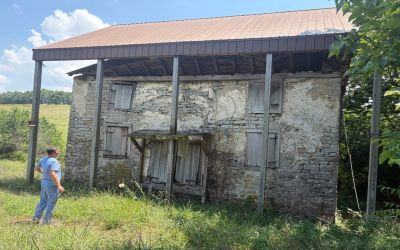
‘The priority is to save this building before it falls down’ The post Kentucky landowner works to preserve, restore 200-year-old Choctaw Academy dormitory appeared first on ICT.
Shopping for a farm in Scott County, Dr. William “Chip” Richardson, a Georgetown ophthalmologist, found one with a feature that grabbed his attention.
“There was this really old building,” said Richardson, who discovered that the stone structure was all that remained of a Native American school established for members of the Choctaw Nation in Kentucky in the early 1800s.
Now he’s immersed in a years-long effort to restore and preserve it.
“I felt like I was rediscovering a piece of American history that had been forgotten,” Richardson said. “The Choctaws were one of the first tribes to realize education was the key to survival.”
Unlike the infamous, native mission schools — established mostly by religious groups and known for abusive treatment and harsh conditions — the Scott County school was founded with support of the Choctaw Nation to provide young men with European-style education tribal leaders believed they would need to succeed, according to historical accounts.
“It’s a very important historic site for the Choctaw Nation,” said Dr. Ian Thompson, tribal historic preservation officer. “We would like to see it restored.”
Tribal leaders believed education through Choctaw Academy and other efforts essential to establish a new generation of leaders, Thompson said.
“The idea was to train Choctaw leaders who already had Choctaw backgrounds in the way that Western leaders perceived the world so they could act with them more effectively,” Thompson said.
He added:” It’s not necessarily that European training was better but they were trying to learn that way so they could interact with them and understand them.”
“An ambitious experiment in education” is how author and history professor Christina Snyder describes it in her 2017 book “Great Crossings,” which includes extensive information about the Choctaw Academy and the Scott County community named for a bison crossing at Elkhorn Creek.
But all this was news to Richardson, who launched his Georgetown medical practice in 2007, and four years later, with his wife, Candy, bought the farm where the school was located.
Fifteen years later, Richardson continues his sometimes-lonely crusade to restore the sole remaining school building — a former dormitory — and establish the site as a National Historic Landmark.
“It’s been nothing but blood, sweat and tears,” Richardson said of the years-long endeavor. “My dream is to one day restore what’s left of the entire school yard.”
Along the way, Richardson has attracted supporters including Dr. Sean Jacobson, a Kentucky native and assistant professor of history at the University of North Alabama, who said the site has a rich history, worthy of recognition.
It includes the Choctaw Academy, the involvement of a former U.S. vice president from Scott County who owned enslaved people — including his common-law wife who helped run the school — and more than 600 students who attended over 23 years.
“I think it’s fascinating,” said Jacobson, who first learned of the Scott County site while doing research as a graduate student.
“Native American history in Kentucky doesn’t end with the arrival of Daniel Boone,” Jacobson said, referring to the frontiersman who explored and helped open Kentucky to pioneer settlers in the late 1700s. “Personally, as a Kentuckian myself, I think it’s really important for people in state of Kentucky to realize how deep and complex their story is.”
The Kentucky Historical Society recognized the site with a historical marker along Highway 460 in 1955. It was listed on the National Register of Historic Places in 1973.
Scott County historian and author Ann Bevins has included the site in her writings, saying it has “huge significance to American history.”
The Choctaw Nation, based in southeast Oklahoma, has no direct ties to Kentucky but supports efforts to preserve the academy site, according to a statement it provided to Richardson.