
Thousands of Intimate Photographs Reveal the Everyday Lives of the Romanovs, Russia's Last Imperial Family
The Bolsheviks executed the last czar, Nicholas II, and the rest of his family, including his famous daughter Anastasia, 108 years ago. Surviving snapshots open a portal into the royals' private world
When Anastasia Nikolaevna Romanov was 11, she sent a lighthearted letter to her father, the Russian czar Nicholas II. “I am sitting and digging in my nose with my left hand,” the young grand duchess reported. Her older sister Olga “wanted to slap me, but I ran away from her swinish hand,” Anastasia recounted with glee.
Undoubtedly the most famous member of Russia’s last imperial family, Anastasia was a “sharp and clever child” with a penchant for practical jokes, a friend later wrote. Photographs of the youngest Romanov daughter testify to her rich sense of humor. In one image, she dons a set of false teeth and strikes a silly pose, even as Olga sleeps in the background. In another, Anastasia grins at the camera as she sneaks a puff of her father’s cigarette.
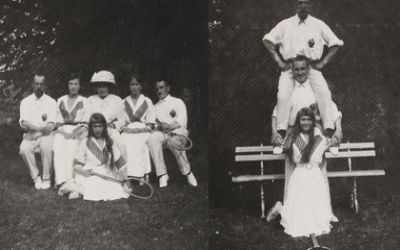
These snapshots and thousands of other surviving photos of the Romanovs preserve every facet of the royals’ lives, from their vacations to their recurring bouts of poor health to their favorite pastimes, including tennis, boating and bicycling. The five children carried their box-shaped Kodak Brownie cameras everywhere, capturing pictures of each other, their parents and their surroundings with a zeal unmatched by Europe’s other royal houses. The family spent many happy evenings pasting images into photo albums, with Anastasia and Maria, the sister she was closest to in age, even colorizing some of their favorites by hand.
Preserved in state archives, museums, university libraries and private collections, the Romanovs’ personal photos were never intended for public consumption. “The feeling one gets, perusing them, is primarily one of voyeurism,” the Yale Alumni magazine noted in 2003. “They are fascinating mostly because of what happened after they were taken.”
In March 1917, amid the upheaval of the Russian Revolution and World War I, Nicholas abdicated the throne, bringing an end to 300 years of Romanov rule. The Bolsheviks executed the former czar and the rest of his family the following year, on the night of July 16-17, 1918.
More than a century later, the Romanovs continue to fascinate, in large part because of “the tragedy of their murder, the brutality of it,” Helen Rappaport, the author of numerous books about the family, tells Smithsonian magazine. “It goes back to the photographs,” the historian explains. “There’s something so very haunting about [seeing] those four lovely girls whose lives were cut short and that handsome and engaging little boy,” their 13-year-old brother, the heir apparent Alexei.
The Romanovs’ photo albums humanize a family that fiercely protected their privacy at the cost of intense criticism over their perceived insularity and inability to relate to everyday Russians. A 1905 Washington Post article titled “Children Without a Smile” expressed a common view of the sheltered siblings, suggesting that “melancholy has marked them for her own.” But the family’s own photos and videos contradict this assessment, capturing Anastasia’s experimental selfies, Alexei with his beloved pets and all of the children playing together on board the imperial yacht.
“What amazed me was how alike those albums were to any other family albums we have,” Natalia Sidlina, the curator of a London exhibition about Nicholas, told the Guardian in 2018. “The Romanovs looked just like any middle-class family.”
Despite appearances, the Romanovs were anything but ordinary. Nicholas was one of the richest men in history, and he wielded absolute power over one-sixth of the world’s landmass. Yet he was better suited to life as a “placid country gentleman, walking amid his flower beds in a linen blouse, with a stick instead of a sword,” as one American diplomat put it. Nicholas himself acknowledged his weaknesses as a ruler: When he ascended to the throne in 1894, the 26-year-old told a cousin that he was “not prepared to be a czar. I never wanted to become one. I know nothing of the business of ruling.”
Nicholas inherited an empire teeming with resentment. His paternal grandfather, Alexander II, had abolished the practice of Russian serfdom in 1861, freeing some 20 million peasants whose lives had long been bound to land they didn’t own. But Alexander didn’t go far enough for the country’s most ardent revolutionaries, who responded to the so-called czar liberator’s reforms by assassinating him in 1881. Perhaps unsurprisingly, the violent nature of Alexander’s death—and the spate of assassinations of public figures that followed—led his successors to reject his modernizing instincts, instead embracing the centuries-old tradition of autocratic rule.
“Russia’s potential could be unlocked only by reforming peasant landownership, by breakneck industrialization based on Western credit, and by broadening political participation and dismantling the corrupt, repressive autocracy, something the last two Romanovs, Alexander III and Nicholas II, were ideologically incapable of doing,” historian Simon Sebag Montefiore writes in The Romanovs: 1613-1918.
The late biographer Robert K. Massie argued that the tragedy of Nicholas’ reign was that he was ill suited to the modern era, a moment when “events were moving too swiftly, ideas were changing too radically.” Unable to adapt, Nicholas brutally suppressed peaceful protests; refused to work with political reformers; and stubbornly insisted on pursuing his own agenda, against the advice of his relatives and advisers.
Throughout his nearly 23-year reign, Nicholas relied heavily on the guidance of his wife, the czarina Alexandra. Born Alix of Hesse, a minor princess from a German grand duchy, she was a favorite granddaughter of Queen Victoria, who’d overseen her upbringing after the death of her mother. Victoria and her husband, Albert, were early adopters of photography, instilling a love of the new technology in their many royal relatives. One of the earliest photos of Nicholas and Alexandra’s firstborn, Olga, features the chubby-cheeked girl in a white dress, perched on her mother’s knee as her great-grandmother looks on admiringly.
The czarina was unpopular from the start, with both Russian aristocrats and everyday citizens criticizing her German origins and seeming antipathy toward her role as consort. Extremely shy, Alexandra protected “her own deeply held insecurities by retreating, at every opportunity, from public view,” Rappaport writes in The Romanov Sisters. “She only succeeded in accentuating her already marked air of chilly reserve.”
Alexandra’s detached demeanor masked an effusive, devout woman who exchanged passionate love letters with her husband and cared deeply for the privileged few whom she took into her confidence. In the view of one of Alexandra’s aunts, she was “very imperious and will always insist on having her own way, and she will never yield one iota of the power she will imagine she wields.”
As czarina, Alexandra’s main duty was to bear a male heir. Despite this looming expectation, the couple celebrated Olga’s birth in 1895. When Alexandra learned the sex of her second child, Tatiana, however, she reportedly cried out, “My God, it is again a daughter. What will the nation say?” Two more girls, Maria and Anastasia, followed by 1901, prompting the press and the extended Romanov family alike to openly express their disappointment. It was only in 1904 that Alexandra gave birth to Alexei.
“It is one of the supreme ironies of history that the blessed birth of an only son should have proved the mortal blow” to the Romanov dynasty, Massie wrote in Nicholas and Alexandra. As the czar and czarina soon learned, Alexei suffered from hemophilia, an incurable and largely untreatable condition that prevents blood from clotting properly. “Imperial Russia was toppled by a tiny defect in the body of a little boy,” Massie explained, with Alexandra, who’d passed the genetic mutation down to her son, taking increasingly desperate measures on Alexei’s behalf.
That, “of course, opened the door to Rasputin,” the Siberian peasant and faith healer widely credited with cementing the family’s downfall, Rappaport tells Smithsonian. As the historian writes in The Romanov Sisters, Alexandra was a “woman whose abiding virtue—and one that, perversely, destroyed them all in the end—was a fatal excess” of maternal love.
To protect the stability of the realm, Alexei’s diagnosis was kept secret from all but a trusted few until 1912, when he was 8. The Romanovs released a bulletin acknowledging that the young heir was on the brink of death after a particularly serious incident. In the years leading up to this disclosure, Alexei’s immediate family “created a protective cocoon around” him, retreating to a smaller palace in Tsarskoye Selo, outside of the bustling capital of St. Petersburg, Rappaport says. “They lived much more private lives after that, which meant they were less accessible” to their subjects, and Alexei was “very rarely seen by the Russian people.”
With few opportunities to see the imperial family in person, Russians looked to official photographs and postcards to gain a sense of their character. “The Romanovs really used photography to publicize and promote an image of the family as this beautiful domestic unit,” Rappaport says. Inevitably, these carefully curated images presented the four grand duchesses as largely indistinguishable sisters who went everywhere in matching white dresses, their expressions serene but somewhat inscrutable.